
 Faire un don


- Chef de service
- Urologie et andrologie
Signaler une erreur sur cette page
Contacter le service
Urologie et andrologie
Secrétariat du Pr KLEINCLAUSS - Chef de service : 03 81 21 91 70
Actualités
-
Culture
L’Ablation le 7 novembre au Scénacle
A l’occasion de Movember®, mois dédié à la lutte contre les cancers masculins, le CHU de Besançon accueille la pièce de théâtre… -
Prévention
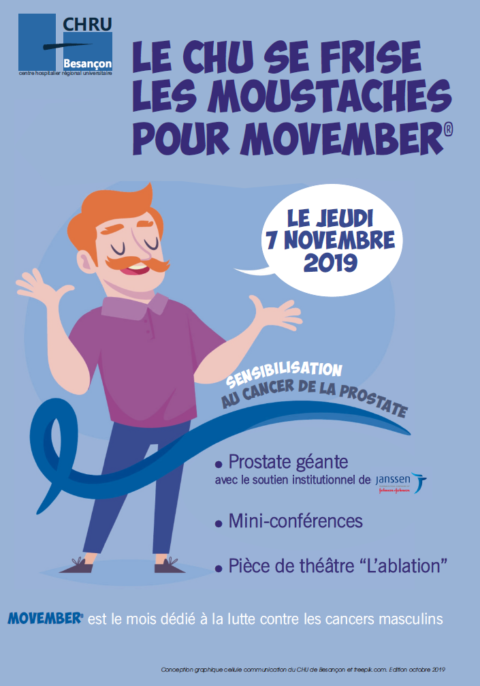
Movember : prostate géante et théâtre pour parler du cancer de la prostate
Movember® est le mois dédié à la lutte contre les cancers masculins. A cette occasion, le CHU de Besançon organise deux évènements…

Contributions aux publications scientifiques du CHU Besançon Franche-Comté
Extraperitoneal versus transperitoneal robot-assisted laparoscopic total prostatectomy : Comparison after propensity score matching.
Article originalThe French journal of urology2026-Oct
Auteurs CHU : Pourchet Maximin, Guichard Guillaume, Kleinclauss François, Frontczak Alexandre
Robot-assisted laparoscopic radical prostatectomy (RALRP) has become the standard surgical approach for the treatment for localized prostate cancer. Two main surgical site access are commonly used: transperitoneal (TP) and extraperitoneal (EP). While high-volume specialized centers have demonstrated comparable outcomes between these two techniques, data from real-world clinical practices remain li
Surgical complications and risk factors in elderly patients after kidney transplantation : A single-center retrospective study.
Article originalThe French journal of urology2026-Oct
Auteurs CHU : M'bongo-Martina Julien, Kleinclauss François, Balssa Loïc, Barkatz Johann, Guichard Guillaume, Frontczak Alexandre
Aging among kidney transplant candidates is associated with increased postoperative morbidity. The determinants of surgical complications and their prognostic impact in elderly recipients remain poorly defined. This retrospective single-center study included kidney transplantations between 2004 and 2022. In recipients aged ≥ 65 years, factors associated with surgical complications within 3months (
Allograft nephrectomy : Indications and surgical techniques. Association Française d’Urologie and Société Francophone de Transplantation guidelines.
Article originalThe French journal of urology2025-Nov
Auteurs CHU : Frontczak Alexandre, Kleinclauss François
After kidney graft failure, the question of maintaining or removing the graft arises. The indications and surgical techniques of transplant nephrectomy as well as the peri-procedure immunosuppressor management are poorly codified and are not the subject of any specific guidelines. The aim of this work was to provide clinical guidelines focused on four clinical questions: (i) indications and timing
High-risk non-muscle invasive bladder cancer : Outcomes of patients who cannot benefit from standard of care.
Article originalThe French journal of urology2025-Apr
Auteurs CHU : Palkowski Thomas, Bibeau Frédéric, Thiery-Vuillemin Antoine, Kleinclauss François, Frontczak Alexandre
High-grade non-muscle invasive bladder cancer (HG-NMIBC) exposes to a high risk of recurrence and progression. Standard of care includes repeated trans-urethral resection of bladder tumor (reTURBT) and bacillus Calmette-Guérin (BCG) therapy. Not following Standard of care (SOC) may be associated with a worse prognosis. We aimed to compare prognosis outcomes of patients with primary HG-NMIBC accord
Kidney transplantation from donors with cancer or history of cancer : Transplantation and cancerology committee of Association Française d’Urologie guidelines (CTAFU/CCAFU).
Revue de la littératureThe French journal of urology2025-Nov
Auteurs CHU : Frontczak Alexandre, Kleinclauss François
Potential donors for transplantation are screened for malignancies that can be transmitted on to the recipient. The discovery of cancer or a history of cancer often leads to contraindications for organ donation, while in some cases the cancer transmission risk is very low. The current context of organ shortage leads us to reconsider the use of organs from donors with cancer or a history of cancer
Voir les 12 autres publications
Symptomatic renal arteriovenous malformation before and after rupture endovascular and surgical approach.
Article originalUrology case reports2025-Jul
Auteurs CHU : Choffel Loic, Simon Gabriel, Frontczak Alexandre, Kleinclauss François
Renal arteriovenous malformations are rare, with significant challenges in management due to their high-flow nature and potential serious complications. We present a case of a 78-year-old female with no significant medical history, who presented with hematuria and right-sided lumbar pain. Imaging revealed a large right renal arteriovenous malformation. Due the size and the location, a surgical app
Concomitant decrease of E- and A-FABP expression predicts worse survival in urothelial bladder cancer patients.
Article originalScientific reports2024-Jul
Auteurs CHU : Saizonou Inès, Monnien Franck, Bedgedjian Isabelle, Kleinclauss François, Algros Marie-Paule, Fauconnet Sylvie
Non-muscle invasive bladder cancers (NMIBC) pTa-pT1 are depicted by a high risk of recurrence and/or progression with an unpredictable clinical evolution. Our aim was to identify, from the original resection specimen, tumors that will progress to better manage patients. We previously showed that A-FABP (Adipocyte- Fatty Acid Binding Protein) loss predicted NMIBC progression. Here we determined by
GW501516-Mediated Targeting of Tetraspanin 15 Regulates ADAM10-Dependent N-Cadherin Cleavage in Invasive Bladder Cancer Cells.
Article originalCells2024-Apr
Auteurs CHU : Kleinclauss François, Fauconnet Sylvie
Bladder cancer aggressiveness is correlated with abnormal N-cadherin transmembrane glycoprotein expression. This protein is cleaved by the metalloprotease ADAM10 and the γ-secretase complex releasing a pro-angiogenic N-terminal fragment (NTF) and a proliferation-activating soluble C-terminal fragment (CTF2). Tetraspanin 15 (Tspan15) is identified as an ADAM10-interacting protein to induce selectiv
ProACT™ (Uromedica, Plymouth, USA) balloons for male urinary incontinence : A fourteen-year-old cohort.
Article originalThe French journal of urology2024-Jul
Auteurs CHU : François Catherine, Chabannes Éric, Kleinclauss François, Frontczak Alexandre
Male urinary incontinence is attributed to SUI consecutive to benign prostate hypertrophy surgery, trauma, neurological diseases, or injury. Medical devices are developed to treat male urinary incontinence among them proACT® balloons. This technique was chosen in our center to achieve continence. Our study aims to evaluate safety and efficacy of proACT® balloons implanted in our center by measurin
Surgical complications and graft survival in kidney transplant recipients according to CT-scans evaluation.
Article originalThe French journal of urology2024-Jan
Auteurs CHU : Choffel L, Kleinclauss F, Balssa L, Barkatz J, Lecheneaut M, Guichard G, Frontczak A
Obesity is a risk factor for significant surgical complications following kidney transplantation. We examined morphometric parameters other than the body mass index (BMI) that could predict surgical complications and determine their impact on graft survival. Kidney transplantations performed at our center between 2012 and 2019 were retrospectively evaluated. Data for visceral adipose tissue (VAT),
Urinary tract infection after flexible ureterorenoscopy for urolithiasis in patients with positive treated preoperative urinalysis.
Article originalUrolithiasis2024-Mar
Auteurs CHU : Simon Jeanne, Kleinclauss François, Chabannes Éric, Bouiller Kevin, Frontczak Alexandre
Prevalence of kidney stones is increasing worldwide, flexible ureterorenoscopy (f-URS) is the most common surgical treatment. Postoperative urinary tract infection (PUTI) is the primary complication. Some risk factors are classically associated with PUTI, especially preoperative positive urinalysis (POPU). We aimed to identify risk factors for PUTI after f-URS for urolithiasis in patients with tre
Young urologists and kidney transplantation training : A survey designed by the French Transplantation Committee of the French Association of Urology (CTAFU) and the French Association of Urologists in training (AFUF).
Article originalThe French journal of urology2024-Jun
Auteur CHU : Kleinclauss François
In France, kidney transplantations (KT) are mainly performed by urologist. Young urologists and residents are involved in this activity mostly performed in emergency. How do they feel about KT training? Is KT an attractive part of the urologist activity? This survey has been designed in the form of a questionnaire by the French Committee of Kidney Transplantation (CTAFU) and the French Association
[Not Available].
ÉditorialProgres en urologie : journal de l'Association francaise d'urologie et de la Societe francaise d'urologie2023-Dec
Auteur CHU : Kleinclauss F
Artificial intelligence to improve cytology performance in urothelial carcinoma diagnosis : results from validation phase of the French, multicenter, prospective VISIOCYT1 trial.
Article originalWorld journal of urology2023-Sep
Auteur CHU : Kleinclauss François
Cytology and cystoscopy, the current gold standard for diagnosing urothelial carcinomas, have limits: cytology has high interobserver variability with moderate or not optimal sensitivity (particularly for low-grade tumors); while cystoscopy is expensive, invasive, and operator dependent. The VISIOCYT1 study assessed the benefit of VisioCyt for diagnosing urothelial carcinoma. VISIOCYT1 was a Frenc
Learning curve in flexible ureteroscopy for renal stones : A propensity score-matched study.
Article originalProgres en urologie : journal de l'Association francaise d'urologie et de la Societe francaise d'urologie2023-May
Auteurs CHU : Frontczak A, Chabannes E, Guichard G, Bernardini S, Barkatz J, Balssa L, Kleinclauss F
To assess the learning curve and evaluate the impact of surgical experience related to the outcomes of flexible ureteroscopy (fURS) for upper urinary tract stones. We evaluated retrospectively lithiasis fURS performed in our institution between January 2004 and December 2020. Patients were divided into two groups by the number of procedures performed by surgeon. Group 1 (G1) included the first 50
[Pelvic floor rehabilitation before prostatectomy : An update].
Revue de la littératureProgres en urologie : journal de l'Association francaise d'urologie et de la Societe francaise d'urologie2022-Nov
Auteurs CHU : Cerutti E, Kleinclauss F, Frontczak A
Preoperative pelvic floor physiotherapy is commonly prescribed to limit postoperative stress urinary incontinence after radical prostatectomy. It can be done in different ways. The objective of this work is to achieve a description of the objectives and existing techniques. A narrative review is carried out based on a non-systematic review of the literature and on the authors' experience. Although
How imaging is changing prostate cancer management – Editorial : Comment l’imagerie peut révolutionner le traitement du cancer de la prostate – Éditorial.
ÉditorialProgres en urologie : journal de l'Association francaise d'urologie et de la Societe francaise d'urologie2022-Jun
Auteur CHU : Kleinclauss F